
Ancient Japanese Ikigai Meets Startup Hustle: Rediscovering Purpose in the Daily Grind
Discover how the Japanese philosophy of ikigai is influencing startup culture in 2026. From founder burnout and venture-backed pressure to purpose-driven decision-making and sustainable growth, explore how aligning meaning with momentum is helping entrepreneurs build resilient, mission-focused companies in today’s fast-moving innovation economy.
10/13/20255 min read
I first heard a founder mention ikigai during what was otherwise a very standard investor update.
Revenue growth: steady. Burn rate: controlled. Hiring roadmap: ambitious. The slide deck moved efficiently from projections to partnerships, from pipeline to potential exits.
Then, almost as an aside, he said, “Lately I’ve been thinking about ikigai.”
There was a pause.
You could almost feel the spreadsheet blink.
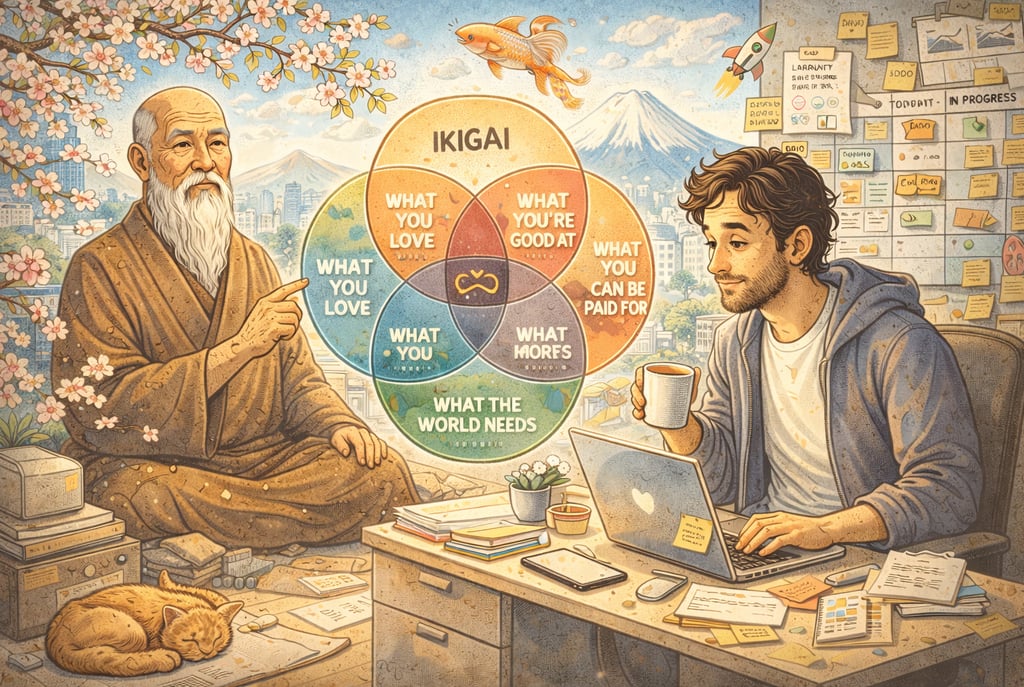
Ikigai — often translated as “a reason for being” — originates in Japanese philosophy and is frequently illustrated as the intersection between what you love, what you’re good at, what the world needs, and what you can be paid for.
Not exactly typical venture capital language.
And yet, over the past few years, I’ve noticed ikigai quietly slipping into startup conversations. Not as branding. Not as a decorative concept on a company values slide. But as something more intimate — a question founders ask themselves when the hustle becomes heavy.
Why are we building this?
Startup culture thrives on speed. Growth charts. Fundraising rounds. Product-market fit. The steady rhythm of “what’s next?”
Ikigai, by contrast, feels unhurried. Personal. Rooted.
It shouldn’t coexist comfortably with venture-backed velocity.
It does.
The Acceleration Engine of Startup Culture
To understand why ikigai feels so unexpectedly at home in startup life, it helps to acknowledge the pace.
Startups move quickly because they must. Runway is finite. Competition is relentless. Markets shift in real time. The mythology of innovation rewards urgency.
Roadmaps compress into sprints. Sprints multiply into quarters. Quarters blur into funding milestones. Founders juggle hiring, product development, investor relations, and customer feedback — sometimes within the same morning.
There is real exhilaration in that momentum. When growth curves rise and users respond enthusiastically, the energy feels electric. Slack channels light up. Product updates roll out. Celebration emojis multiply.
But acceleration carries strain.
A 2023 founder well-being survey revealed that more than 70% of startup leaders experienced prolonged periods of emotional exhaustion. Not because they lacked passion. Often because their identity became entangled with their metrics.
When funding closes, relief floods in. When deals stall, doubt creeps quietly.
And in the constant recalibration of expectations, purpose can slip into the background.
Ikigai reintroduces it — not loudly, but persistently.
What Ikigai Really Asks
Ikigai is often reduced to a tidy Venn diagram.
What you love.
What you’re good at.
What the world needs.
What you can be paid for.
The diagram is helpful, but incomplete.
In Okinawa, where the concept gained attention due to the region’s high life expectancy, ikigai is less about career alignment and more about daily meaning. It is a reason to wake up. A small, steady contribution.
Applied to startup culture, this becomes quietly transformative.
Instead of asking only, “How do we scale?” founders begin asking, “Why does this matter to me personally?”
Instead of framing success solely through valuation, they examine whether their work feels aligned with something deeper than momentum.
This is not a rejection of growth.
It is a recalibration of it.
Where Worlds Collide: Founders Reflecting in Real Time
A health-tech founder shared with me a moment of unexpected clarity after a missed Series A milestone.
“I realized I was chasing validation more than vision,” she said. “I had started optimizing for what would impress investors instead of what originally compelled me.”
She took a week away — not for a dramatic pivot, but for reflection. She revisited why she entered healthcare technology in the first place. Accessibility. Dignity. Family experience.
When she returned, the roadmap changed subtly. Features that looked impressive but didn’t serve core users were deprioritized. Partnerships shifted toward community clinics instead of larger corporate contracts.
Revenue dipped briefly.
Then it stabilized.
Employee engagement increased. Customer feedback improved. The company’s internal conversations felt less frantic.
Ikigai didn’t slow growth.
It clarified it.
The delightful dissonance of introspective philosophy meeting aggressive scaling resolved into unexpected harmony.
The Practical Harmony of Purpose and Profit
There is a persistent myth that purpose and profitability operate in tension.
Yet companies with clearly articulated missions often demonstrate greater resilience. When internal motivation aligns with external opportunity, decision-making accelerates.
Clarity reduces distraction.
A fintech founder I interviewed described using a simple exercise during leadership retreats. Each executive answers one question privately before group discussion: “If this company disappeared tomorrow, what loss would I personally feel?”
The responses shape strategy.
If the loss would be financial only, something feels incomplete. If the loss would feel like abandoning a meaningful contribution, alignment strengthens.
It sounds reflective.
It is also operational.
Teams aligned around shared purpose experience lower turnover. Lower turnover preserves institutional knowledge. Institutional knowledge sustains growth.
Purpose becomes infrastructure.
Visual Integration: The Whiteboard Revisited
Imagine a founder standing alone in an office at dusk.
The whiteboard behind them is covered in growth projections. Market segmentation charts. Funding timelines. Competitive analysis notes.
In the corner, in smaller handwriting, one question: “Why does this matter?”
Take a moment with that image.
The numbers remain. The ambition remains.
But the presence of that question changes the atmosphere.
The hustle inhales.
Redefining Hustle Through Alignment
Startup hustle is often framed as relentless.
Late nights. Early mornings. Endless iteration. The mythology celebrates endurance.
Ikigai introduces a gentle distinction: is the hustle aligned?
Working intensely toward something deeply meaningful feels different from chasing velocity for its own sake.
A product designer in a fast-scaling SaaS company described the difference succinctly: “When I know why we’re building this, I can work hard without feeling hollow.”
Hollow.
That word carries weight.
Ambition without grounding can feel hollow. Ikigai fills that space quietly.
Not with grand gestures.
With clarity.
The Emotional Undercurrent of Scaling
As startups grow, complexity increases.
New hires arrive with different motivations. Investors bring varied expectations. Media narratives amplify pressure. Original intentions risk dilution.
Some founders now integrate purpose reflection into onboarding processes. New employees are invited to articulate why the mission resonates personally. These reflections are revisited during quarterly reviews.
It doesn’t dominate strategy decks.
It doesn’t slow operations.
But it builds cohesion.
Shared meaning reduces friction. Reduced friction sustains momentum.
Again, the pairing feels unexpectedly coherent.
Ikigai as Resilience Mechanism
The startup ecosystem in 2026 operates within heightened volatility.
AI reshapes industries rapidly. Market saturation intensifies. Economic cycles compress unpredictably.
In such an environment, external validation fluctuates.
Purpose, by contrast, stabilizes internally.
When founders root decisions in personal meaning, setbacks feel instructive rather than existential. Funding delays become strategic recalibrations. Product misfires become learning moments.
Ikigai doesn’t eliminate stress.
It contextualizes it.
Context transforms panic into proportion.
A Gentle Recalibration of Success
Ikigai reframes what success looks like.
Valuation becomes milestone rather than identity. Revenue becomes fuel rather than proof of worth. Daily work becomes contribution rather than competition.
The charming contradiction of ancient Japanese philosophy meeting venture-backed ambition reveals something quietly mature.
Speed benefits from direction.
Direction benefits from meaning.
Meaning benefits from reflection.
Reflection does not stall momentum.
It steadies it.
Sustainable Growth Over Spectacle
There is something appealing about spectacle in startup culture. Big launches. Headline funding rounds. Rapid user acquisition graphs.
Ikigai shifts attention toward sustainability.
A founder building climate-tech solutions described turning down a flashy but misaligned partnership opportunity because it diluted mission clarity.
“It would have looked impressive,” he said. “But it didn’t feel right.”
That decision did not make headlines.
It made the company more coherent.
Coherence often outlasts spectacle.
The Broader Reflection
When ancient Japanese ikigai meets startup hustle, something unexpectedly balanced emerges.
Ambition gains depth.
Growth gains grounding.
Scaling gains intention.
The pairing feels strangely right because both traditions value impact.
One measures it numerically.
The other measures it internally.
Together, they create sustainable drive.
Not frantic expansion.
Purposeful progress.
It shouldn’t fit easily.
It does.
Have you noticed other quiet philosophical influences shaping modern business culture? The small ideas that softened sharp edges without dulling ambition?
We’re collecting those.
Until the next thoughtful fusion appears in a roadmap, a pitch deck, or a late-night founder reflection.
More quiet wonders soon.