
Embedded AI Meets Everyday Decision-Making: The Surprisingly Coherent Way Tech Fades into the Background
Discover how embedded AI is transforming everyday decision-making in 2026. From intelligent email sorting and automated meeting summaries to proactive budgeting alerts and adaptive scheduling, explore how ambient AI tools are reducing cognitive load, increasing focus, and allowing technology to fade seamlessly into the background of modern life.
1/12/20265 min read
I realized something had changed the day I stopped noticing it.
A meeting invitation appeared already adjusted for time zones. A recap of a client call was waiting in my notes app before I thought to draft one. A reminder surfaced to reorder printer ink at exactly the moment I saw the cartridge warning blink.
There was no dramatic prompt. No visible “Ask AI” button glowing in the corner of the screen. No moment of orchestration.
It simply… happened.
For years, interacting with artificial intelligence felt like an event. You opened a tool. You typed a query. You refined your instructions. You watched the output arrive.
Now, increasingly, AI lives inside the tools we already use. It observes patterns quietly. It anticipates recurring needs. It drafts, sorts, flags, and nudges — without demanding applause.
And then it recedes.
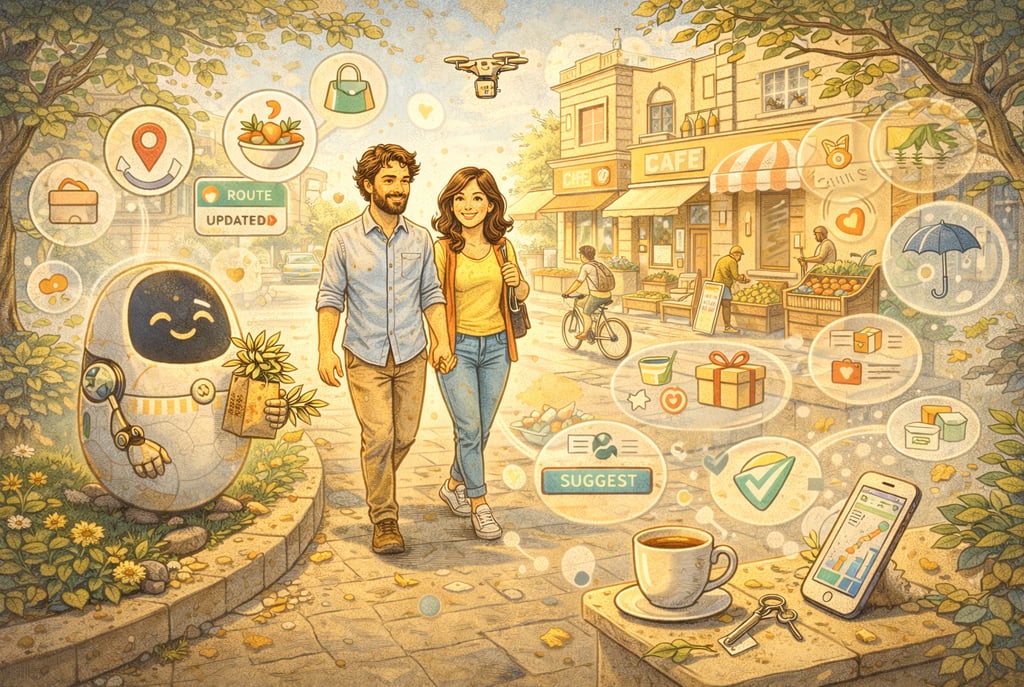
Embedded AI doesn’t announce itself with spectacle. There is no glossy demo moment. It blends into email clients, project boards, financial dashboards, grocery apps, thermostats, and navigation systems.
It shouldn’t feel powerful when technology becomes less visible.
It does.
Because when AI fades into the background, something else quietly returns.
Attention.
From Prompting to Presence
The first wave of mainstream AI required deliberate engagement.
You prompted. It responded. You refined. It recalculated.
The relationship was explicit and slightly performative. You were aware of the tool. The tool was aware of your query.
Embedded AI shifts that dynamic entirely.
Your calendar proposes meeting times based on historical behavior. Your email app prioritizes messages that align with past urgency patterns. Your shopping app anticipates when household staples will likely run out.
You do not ask.
You receive.
A product designer described this shift as “moving from tool to atmosphere.” That phrasing lingers because it captures something subtle.
Atmosphere does not interrupt.
It shapes quietly.
The Architecture of Micro-Decisions
A typical day contains hundreds of micro-decisions.
Should this email be answered now or later?
Is this meeting necessary?
Did I respond to that client?
Should I leave early to avoid traffic?
Is my energy better suited for creative work or administrative tasks right now?
Individually, these decisions are minor.
Collectively, they generate cognitive load.
Psychologists have long described decision fatigue as the gradual erosion of clarity across repeated choices. Even small decisions consume mental bandwidth.
Embedded AI reduces friction at that granular level.
A startup founder described her scheduling assistant as “the colleague who handles logistics without drama.” It scans calendars across time zones, proposes optimal windows, and inserts buffer time based on prior patterns.
She no longer negotiates time slots through endless email chains.
Another example: a budgeting app that categorizes transactions automatically and flags unusual spending gently.
“Did you mean to increase travel expenses this month?” it asks.
It doesn’t accuse.
It suggests.
It shouldn’t feel liberating to outsource micro-decisions.
It does.
Visual Integration: The Calm Dashboard
Imagine opening a project management dashboard.
Instead of a chaotic list of overdue tasks blinking in red, you see a prioritized queue. Deadlines sorted intelligently. Dependencies mapped quietly. Suggestions for which task to address first based on previous productivity patterns.
There is no AI badge flashing.
Just clarity.
Take a moment with that image.
The technology is present.
But it does not dominate the field of view.
Email Without Exhaustion
Email remains one of the most persistent sources of cognitive friction.
Unread messages accumulate. Tone is misinterpreted. Urgency is unevenly distributed.
Embedded AI addresses this friction without ceremony.
Priority inboxes surface critical messages. Draft replies appear automatically, informed by previous threads. Suggested attachments are pulled into composition windows before you search manually.
A marketing director described noticing something subtle after enabling automated sorting.
“I didn’t realize how tense I felt opening my inbox,” she said. “Now, the important things float to the top.”
The relief was not dramatic.
It was steady.
Technology did not disappear.
It became quieter.
Everyday Decisions Beyond Work
Embedded AI does not limit itself to professional workflows.
Navigation apps adjust routes before congestion becomes visible. Smart thermostats regulate temperature based on occupancy patterns. Streaming platforms curate recommendations informed by subtle preference shifts.
Even grocery apps anticipate replenishment cycles. If you buy oat milk every ten days, the reminder appears on day nine.
You are spared the mental note.
The cumulative effect is subtle but significant.
Less remembering.
Less scanning.
Less adjusting.
The delightful dissonance of complex machine learning operating invisibly resolves into coherence because it mirrors human preference for seamless support.
The Emotional Undercurrent of Invisible Assistance
There is something deeply calming about assistance that does not require acknowledgement.
Earlier technological eras often equated innovation with visibility. Notifications, badges, alerts — proof that something was happening.
Embedded AI moves in the opposite direction.
It absorbs noise.
A remote team lead described how automated meeting summaries reduced tension. “We used to argue about who would take notes,” she explained. “Now the summary just appears.”
The conflict dissolved without ceremony.
When friction decreases quietly, stress often decreases quietly as well.
Relief does not always arrive with fanfare.
The Trust Equation
Invisibility requires trust.
When AI categorizes emails or flags financial anomalies, users must feel confident that autonomy remains intact.
A financial advisor noted that clients are more receptive to AI-generated insights when suggestions are framed as optional rather than prescriptive.
“Consider reviewing this expense pattern” feels different from “You are overspending.”
Language shapes perception.
Embedded AI that respects agency fosters confidence.
It should assist.
Not override.
When Tech Stops Feeling Like Tech
There is an interesting psychological shift occurring.
As AI integrates seamlessly, it begins to feel less like “technology” and more like infrastructure.
Electricity is no longer impressive. It is expected. Plumbing is invisible. It simply works.
Embedded AI may follow a similar trajectory.
When predictive assistance becomes normalized, novelty fades. What remains is utility.
The most transformative AI systems may not be those with the flashiest interfaces, but those that recede entirely.
It shouldn’t feel revolutionary to have fewer decisions to manage.
It does.
The Reframing of Efficiency
Efficiency has traditionally been framed as acceleration.
Do more. Move faster. Increase output.
Embedded AI reframes efficiency as subtraction.
Fewer interruptions.
Fewer manual adjustments.
Fewer redundant confirmations.
The outcome is not frantic speed.
It is smooth continuity.
Continuity sustains focus more effectively than bursts of acceleration.
Why This Resonates in 2026
In 2026, technology saturation is high.
People are weary of new platforms demanding onboarding rituals and constant attention. The novelty curve flattens quickly.
What endures is integration.
Embedded AI requires minimal ceremony. It exists within familiar interfaces. It reduces friction rather than adding novelty.
The quiet revolution of ambient intelligence may shape daily life more profoundly than any headline-grabbing breakthrough.
It shouldn’t feel significant when technology becomes quieter.
It does.
Because quiet systems create spacious minds.
The Broader Reflection
When embedded AI meets everyday decision-making, something unexpectedly elegant emerges.
Technology fades.
Attention sharpens.
Mental bandwidth expands.
The most powerful AI in 2026 may not be the one you actively consult.
It may be the one you barely notice.
The charming contradiction of advanced intelligence dissolving into background presence reveals something mature about this technological moment.
Innovation no longer needs spectacle.
It can integrate.
Have you noticed tools that quietly improved your day without demanding recognition? Subtle automations that gave you space back?
We’re collecting those.
Until the next thoughtful fusion of technology and daily life appears.
More quiet wonders soon.