
Mindfulness Practices Meet Corporate OKRs: How Goal-Setting Learned to Breathe
Discover how mindfulness practices are reshaping corporate OKRs in 2026. From breathing rituals in quarterly planning sessions to reflective performance reviews and psychological safety in remote teams, explore how intentional pauses and present-moment awareness are transforming goal-setting into a more sustainable, human-centered approach to high performance.
8/11/20255 min read
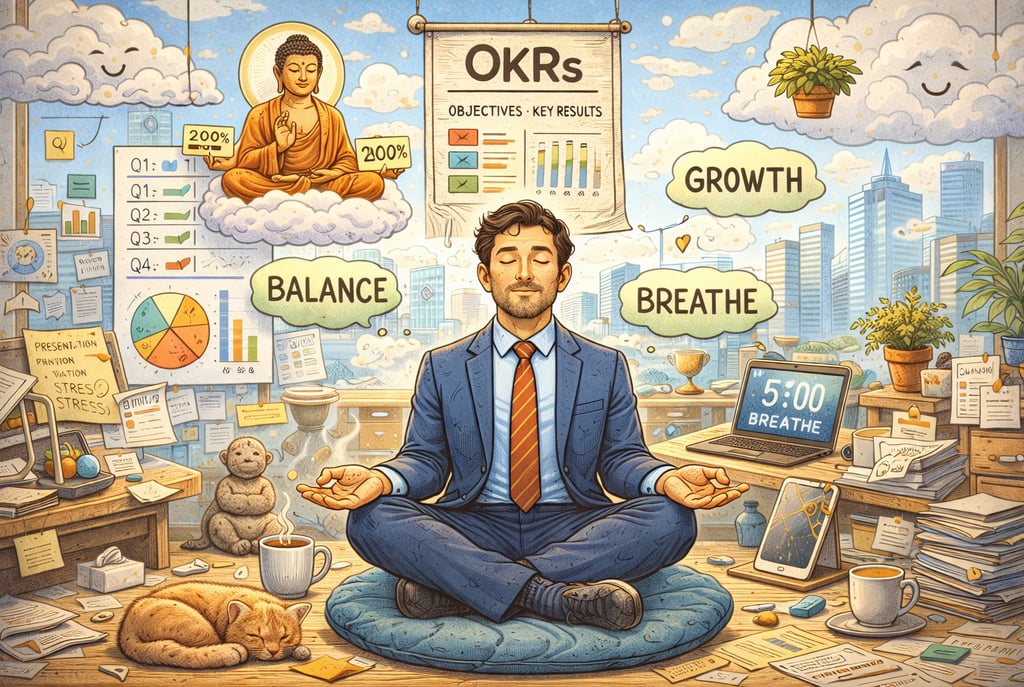
The first time I heard about a quarterly planning session that began with two full minutes of silence, I assumed it was a wellness retreat.
It wasn’t.
It was a SaaS company in Chicago. Revenue projections already loaded into the deck. Stretch targets bolded in reassuring corporate blue. Slack notifications still trickling in at the edge of the screen as everyone joined the call.
And then the facilitator said, “Before we begin, let’s just breathe.”
Cameras stayed on. No one advanced slides. No one typed in the chat. Two minutes passed — long enough to feel slightly awkward, short enough to feel manageable.
It shouldn’t have changed the tone of the meeting.
It did.
The conversation that followed wasn’t slower. It wasn’t less ambitious. But it felt less brittle. Less defensive. People spoke in full sentences. Pauses appeared between responses. Even disagreements carried a softer edge.
Over the past few years, I’ve started noticing this quiet pairing more often: mindfulness practices slipping into corporate goal-setting frameworks. Not as an HR perk tucked into a benefits portal, but woven into the very machinery of execution.
Mindfulness and OKRs — objectives and key results — don’t sound like natural companions. One conjures stillness. The other implies acceleration.
And yet, the more closely you look, the more the pairing feels not only coherent, but quietly necessary.
It shouldn’t fit.
It does.
The Culture of Measured Ambition
OKRs are the architectural beams of modern performance culture.
Originally popularized in Silicon Valley, the framework promises clarity: define ambitious objectives, attach measurable key results, review quarterly, adjust accordingly. It’s tidy. Transparent. Motivating when aligned.
In distributed teams especially, OKRs offer a common language. Everyone can see what matters. Everyone understands what success looks like.
But clarity carries weight.
When objectives become identity markers rather than directional guides, pressure accumulates. Missed targets feel personal. Green dashboards feel like validation. Red ones can cast long emotional shadows.
In remote environments, that emotional undercurrent can intensify. Without hallway conversations or informal reassurance, numbers speak louder than nuance. A spreadsheet cell turning red can feel disproportionately loud.
This is where mindfulness enters — not as a decorative addition, but as structural support.
Not to reduce ambition.
To stabilize it.
What Mindfulness Really Brings to the Table
Mindfulness is often misunderstood as relaxation.
In corporate contexts, it’s sometimes reduced to meditation apps, lunchtime yoga, or breathing exercises framed as stress relief.
But at its core, mindfulness is deliberate attention. It is the practice of observing thoughts, emotions, and reactions without immediately attaching to them.
Applied to goal-setting, that subtle shift becomes powerful.
When a team reviews quarterly results through a mindful lens, the conversation changes. Instead of asking, “Why did we fail?” they begin with, “What are we noticing?”
Instead of rushing to assign accountability, they pause long enough to identify assumptions embedded in their original targets.
Mindfulness doesn’t dilute rigor.
It clarifies perspective.
And perspective reduces panic.
Where Worlds Collide: Planning Rooms with Pauses
I spoke with an operations director at a growth-stage company who integrated brief mindfulness rituals into OKR cycles almost experimentally.
Each quarterly kickoff begins with three minutes of silent reflection. The prompt appears on a simple slide: “What intention do you want to bring to this quarter?”
Not “What do you need to prove?”
Not “How do we outperform last quarter?”
Just intention.
At first, employees found it slightly uncomfortable. The silence felt exposed. Cameras were on. No one wanted to appear overly earnest.
But over time, something shifted.
Discussions grew more measured. When debating stretch goals, team members referenced not only ambition but capacity. Burnout conversations surfaced earlier. Deadlines became more realistic.
“It’s not that we lowered standards,” the director explained. “We just became more aware of how we set them.”
That awareness changed tone.
Breath Inside the Metrics
There’s something almost poetic about pairing breath with benchmarks.
Imagine a large screen displaying quarterly revenue targets. Numbers in bold. Graphs rising and falling. Before advancing to the next slide, the facilitator says, “Let’s take one breath together.”
It sounds minimal. Almost symbolic.
Yet research in organizational psychology suggests that even brief collective pauses can reduce reactive communication and increase psychological safety. In one leadership cohort study, teams incorporating short mindfulness exercises reported higher perceived trust and lower interpersonal friction after six months.
Trust, as it turns out, correlates strongly with performance.
Calm doesn’t slow growth.
It stabilizes it.
The delightful dissonance of breath meeting benchmark resolves into harmony because both seek clarity — one internally, one externally.
The Language Shift That Follows
Perhaps the most fascinating transformation appears in language.
Traditional OKR meetings are full of achievement verbs: hit, crush, exceed, dominate.
Mindful teams gradually incorporate process-oriented language: explore, refine, align, adjust.
A CFO I spoke with changed a single question in performance reviews. Instead of beginning with, “Did you hit your targets?” she now asks, “What did you learn pursuing this objective?”
The shift feels subtle.
It isn’t.
Learning reframes missed metrics as information rather than indictment.
Failure becomes data.
Data becomes adjustment.
Adjustment becomes resilience.
Resilience sustains performance far longer than adrenaline ever could.
Psychological Safety as Infrastructure
One unexpected byproduct of mindfulness inside OKR systems is increased psychological safety.
When teams pause before reacting to underperformance, defensiveness decreases. Individuals feel less threatened by imperfect results. Conversations become exploratory rather than accusatory.
An engineering manager described introducing a 60-second silent pause before retrospective discussions. During that minute, participants jot down observations without speaking.
“It lowered interruptions,” he said. “People listened more. We uncovered better insights.”
It’s not dramatic. It doesn’t photograph well. But it shifts culture incrementally.
Psychological safety becomes infrastructure.
And infrastructure quietly supports everything else.
Visual Integration: A Planning Room Reimagined
Imagine two planning rooms.
In the first: fluorescent lighting, slide decks dense with bullet points, participants leaning forward, pens tapping, tension subtle but present.
In the second: similar metrics on screen, but the meeting opens with a quiet moment. A single slide reads, “What matters most this quarter?” The lighting is softer. The conversation measured.
Take a moment with that contrast.
The ambition hasn’t disappeared. The goals remain. But the atmosphere carries steadiness.
It’s the same framework, inhaling.
Why This Resonates Now
The acceleration of digital work has compressed cycles.
AI tools increase production speed. Market volatility shifts priorities quickly. Remote teams operate across time zones, often asynchronously.
In such an environment, unchecked urgency becomes unsustainable.
Mindfulness offers counterbalance.
It reminds leaders that clarity emerges from attention, not haste. That sustainable growth requires emotional regulation. That high performance and inner steadiness are not mutually exclusive.
In fact, they may depend on each other.
It’s not about slowing down indefinitely.
It’s about breathing between sprints.
A Gentle Recalibration of Success
Mindfulness inside OKR frameworks doesn’t soften targets.
Revenue still matters. Growth still matters. Accountability remains essential.
But identity loosens its grip on outcomes.
When a quarter underperforms, mindful teams reflect before reacting. They ask what assumptions shaped their objectives. They adjust without shame spirals.
Leaders communicate recalibration with steadiness rather than alarm.
The result is not complacency.
It’s proportion.
And proportion may be the most underrated executive skill of 2026.
Sustainable Momentum
The quiet charm of this pairing lies in sustainability.
OKRs provide structure and direction. Mindfulness provides awareness and emotional regulation.
Together, they create momentum that doesn’t rely on panic.
Ambition gains awareness.
Metrics gain context.
Execution gains humanity.
The charming contradiction of stillness meeting speed becomes surprisingly coherent.
It shouldn’t fit.
It does.
The Broader Reflection
When mindfulness practices meet corporate OKRs, we witness something gently subversive.
Performance culture inhales.
Numbers remain. Targets remain. Deadlines remain.
But beneath them runs a steadier current — an acknowledgment that clarity begins inside the room before it appears on a dashboard.
In a world accelerating toward automation and AI-driven efficiency, the most radical act may be a shared pause.
A breath before reaction.
A reflection before recalibration.
An intention before execution.
It is not flashy. It does not trend.
But it lingers.
Have you noticed other quiet mashups in business that softened sharp edges without dulling ambition? The thoughtful fusions that made you pause and think, “That’s surprisingly coherent.”
We’re collecting those.
Until the next gentle collision appears in the quarterly calendar.
More quiet wonders soon.