
Minimalist Lifestyle Meets Agentic AI Tools: The Quiet Joy of Less That Does More
Discover how minimalist lifestyle philosophy is aligning with the rise of agentic AI tools in 2026. From background AI assistants and automated meeting summaries to streamlined workflows and reduced digital clutter, explore how intentional tech integration is helping professionals reclaim focus, reduce cognitive overload, and experience the quiet joy of less that truly does more.
9/15/20255 min read

I used to collect productivity apps the way some people collect reusable water bottles.
Each one promised clarity. Focus. A fresh start. This one would finally organize my tasks. That one would bring my inbox to zero. Another claimed it would “transform my mornings.” I downloaded them with hope and uninstalled them with mild embarrassment.
My physical desk was tidy — a laptop, one notebook, a ceramic mug that had survived several life phases. My digital life, however, resembled a drawer of tangled charging cables. Tabs open in three browsers. Overlapping calendars. Notifications from tools I couldn’t quite remember setting up.
Then something shifted.
It wasn’t dramatic. No grand digital detox. No public declaration that I was abandoning modern productivity culture. Just a quiet question I began asking before adding anything new: does this reduce friction, or does it add to it?
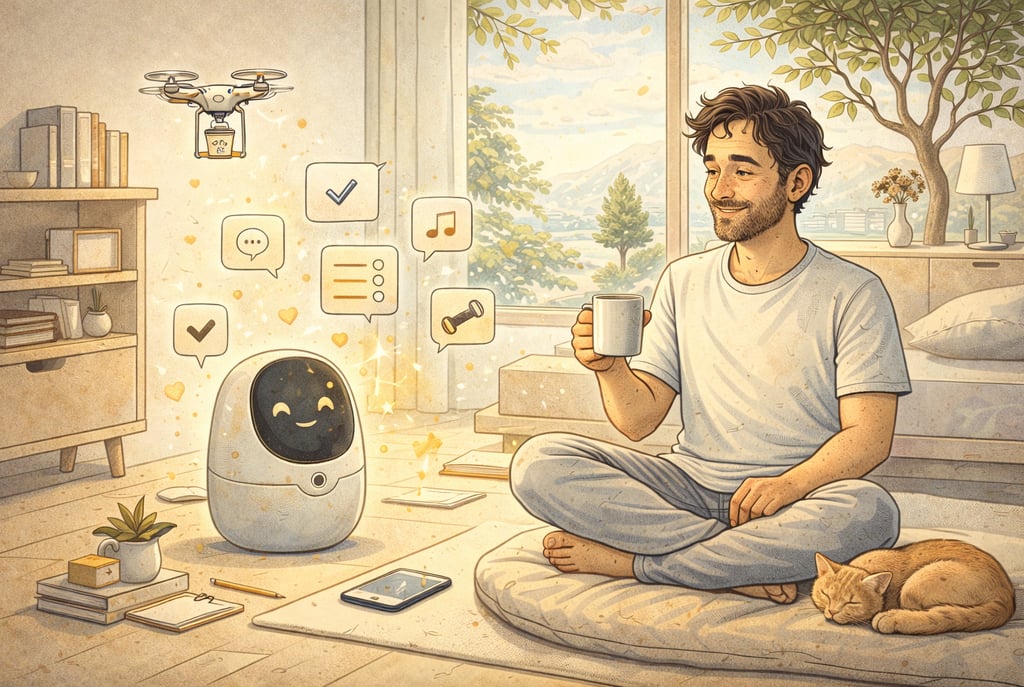
Around the same time, a new generation of AI tools began behaving differently. They weren’t asking to be prompted constantly. They weren’t demanding configuration rituals every morning. They simply… worked in the background.
Meeting summaries appeared automatically. Calendar conflicts were flagged before they caused stress. Email drafts materialized quietly, aligned with previous conversations.
Minimalism and artificial intelligence don’t immediately sound compatible. One suggests reduction. The other implies expansion.
And yet, the more I observed this pairing in real workflows, the more it felt not contradictory, but surprisingly coherent.
It shouldn’t fit.
It does.
The Quiet Accumulation of Digital Clutter
We talk often about physical clutter. Closets overflowing. Counters crowded. Garages turned into storage museums of former intentions.
Digital clutter is less visible. But it accumulates with equal enthusiasm.
For years, the productivity narrative revolved around addition. Install this tool. Integrate that system. Layer automation on top of workflow on top of workflow. The promise was simple: more tools equal more efficiency.
And to be fair, many tools delivered value.
But each one required setup. Preferences. Notifications. Updates. Mental bandwidth. Even the act of optimizing a tool required time and cognitive load.
A marketing manager I spoke with described spending two full weekends migrating between task management platforms because a new feature seemed promising. “It felt productive,” she admitted. “But it was really just rearranging the same to-do list.”
The irony is gentle but persistent: in pursuit of clarity, we sometimes multiply complexity.
Minimalism offers a counterpoint. It asks what can be removed. What truly adds value. What simply creates noise.
Agentic AI, interestingly, approaches the same problem from the opposite direction. Instead of asking what to delete, it asks what can be absorbed.
What Makes AI “Agentic” — and Why It Feels Different
Earlier generations of AI tools were reactive.
You prompted. They responded. You configured. They waited. Their usefulness depended heavily on how skillfully you interacted with them.
Agentic AI behaves differently.
It observes patterns. It anticipates recurring tasks. It drafts before you ask. It suggests before you search.
Imagine opening your inbox and discovering that routine client replies have already been drafted, drawing from previous threads and matching your tone. Or finishing a Zoom meeting and seeing a structured summary appear in your notes app, complete with highlighted action items and suggested deadlines.
No extra step required.
The tool doesn’t demand your attention.
It quietly returns it.
That distinction feels important.
Traditional productivity tools often ask you to adapt to them. Agentic AI adapts to you.
Minimalism thrives on that kind of subtlety.
The Practical Harmony of Less Touchpoints
Minimalism is not about deprivation. It is about intentionality.
Keep what serves you. Remove what distracts.
When agentic AI is integrated thoughtfully, something interesting happens: the number of digital touchpoints decreases.
A startup founder I interviewed recently described deleting three separate tools after integrating an AI workspace that handled scheduling, task reminders, and meeting summaries.
“It’s not that I’m doing less work,” he clarified. “I’m just touching fewer surfaces.”
Touching fewer surfaces.
There’s something quietly luxurious about that phrase.
Instead of bouncing between tabs to gather context, information converges into one place. Instead of manually copying notes into a task manager, tasks are extracted automatically. Instead of toggling calendars, conflicts are flagged proactively.
The reduction is subtle. The impact accumulates.
It shouldn’t feel liberating to eliminate micro-decisions.
It does.
Where This Shows Up in Real Workflows
Consider a distributed team operating across three time zones.
Previously, coordination required manual effort. Meeting notes typed in haste. Follow-up emails drafted from memory. Tasks transferred between platforms.
With agentic AI embedded into their workflow, the process shifts.
Meetings are transcribed automatically. Action items are identified and assigned based on conversational cues. Summaries are shared without anyone staying up late to compose them.
The team still works hard. But coordination consumes less energy.
Or imagine a freelance consultant managing ten clients. Previously, she might spend hours drafting similar introductory proposals or responding to recurring inquiries.
Now, her AI assistant drafts initial responses based on stored preferences and scope parameters. She reviews, refines, and sends.
Her role shifts from repetitive composer to thoughtful editor.
Less repetition.
More presence.
A Visual Meditation: The Calm Desktop
Picture a desk at 8:30 in the morning.
A single laptop. One notebook with a few handwritten reminders. A plant catching soft window light. No second monitor glowing with redundant dashboards. No tablet chiming with cross-synced alerts.
On the laptop screen: a clean interface. Today’s tasks surfaced automatically based on yesterday’s conversations. A meeting summary generated quietly in the corner. A calendar adjustment suggested before overlap occurs.
Take a moment with that image.
Notice how physical simplicity mirrors digital simplicity.
Minimalism does not mean fewer capabilities.
It means fewer distractions between intention and action.
The Emotional Undercurrent of Background Support
There is something deeply reassuring about tools that fade.
In recent years, AI has often been presented with spectacle. Bold announcements. Dramatic demos. Grand promises of transformation.
Yet the most transformative experiences often feel quieter.
A designer once told me, “If I notice the tool too much, it’s probably not well integrated.”
That idea lingers.
The best lighting is barely noticeable. The best user interface feels intuitive. The best AI assistant operates without fanfare.
Minimalist philosophy echoes this sentiment. Remove the unnecessary. Let what remains serve quietly.
When AI becomes ambient rather than intrusive, it aligns with that ethos beautifully.
It doesn’t clutter your attention.
It protects it.
Guardrails: When Less Still Requires Intention
Of course, minimalism does not mean indiscriminate automation.
Agentic AI can create its own form of clutter if layered without discernment. Over-automation can distance us from tasks that require nuance.
The key is intentional integration.
Which processes are repetitive and draining?
Which decisions are predictable and safe to automate?
Where does human judgment add irreplaceable value?
A creative director I spoke with uses AI to draft meeting summaries and organize assets, but writes all conceptual briefs manually. “Automation handles logistics,” she explained. “I keep authorship.”
That boundary feels thoughtful.
Minimalism and AI intersect most elegantly when clarity guides configuration.
The goal is not maximum automation.
It is maximum alignment.
Why This Resonates in 2026
Digital overwhelm has become normalized.
We toggle constantly. Notifications fragment attention. The line between work and personal life blurs into a continuous scroll.
In that context, fewer surfaces feel restorative.
Agentic AI consolidates instead of expands. It absorbs friction rather than adding layers.
Minimalism provides the philosophical lens. AI supplies the operational muscle.
Together, they create sustainable efficiency.
Not frantic optimization.
Steady flow.
The delightful dissonance of reduction meeting technological expansion resolves into coherence because both seek intentionality.
Keep what matters.
Automate what drains.
Protect attention.
The Broader Reflection
When minimalist lifestyle philosophy meets agentic AI tools, something quietly radical emerges.
Technology becomes less visible.
Human attention becomes more protected.
Work shifts from coordination to contribution.
The pairing feels strangely right because both traditions value clarity.
Minimalism removes excess.
Agentic AI absorbs friction.
Together, they create space.
In a world accelerating toward complexity, the quiet joy of less that does more may be one of the most sustainable design philosophies available.
It shouldn’t feel revolutionary.
It does.
Have you noticed other gentle technology shifts that felt calming rather than overwhelming? Tools that faded into the background and gave you space back?
We’re collecting those.
Until the next thoughtful fusion appears on your desktop.
More quiet wonders soon.