
Philosophy of Presence Meets Voice-First Interfaces: When AI Stops Feeling Like a Tool
Explore how voice-first AI interfaces are transforming human interaction in 2026. From screen-free meeting summaries and real-time translation to conversational brainstorming and ambient note-taking, discover how the philosophy of presence is shaping AI tools that feel less intrusive, reduce screen fatigue, and seamlessly integrate into daily life.
2/16/20265 min read
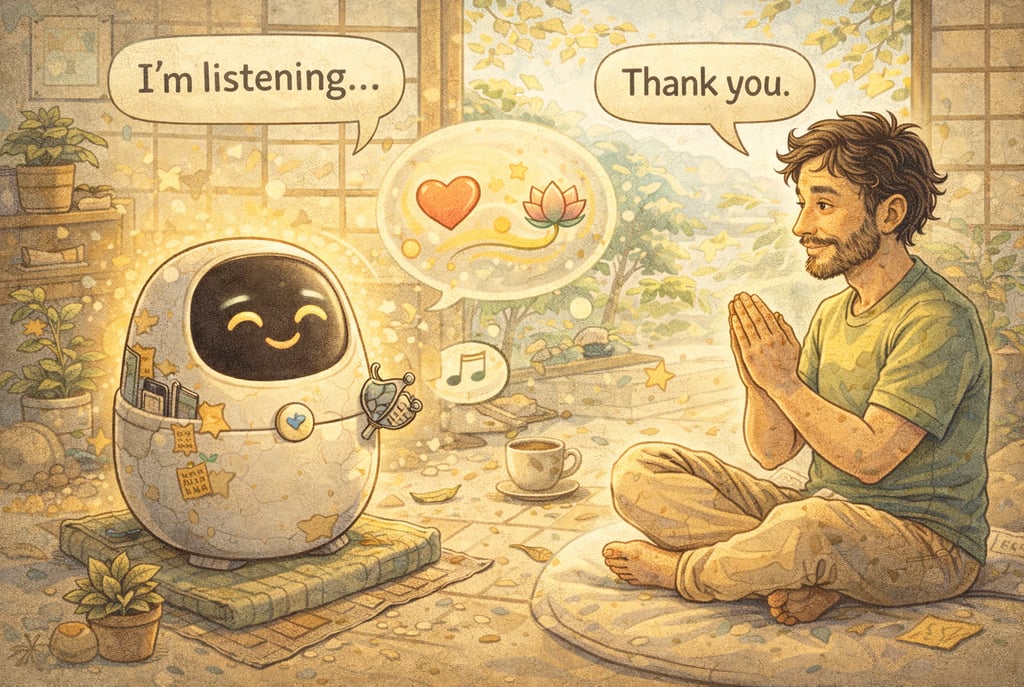
I noticed the shift the first time I didn’t reach for a keyboard.
Instead, I just spoke.
“Summarize yesterday’s client call and highlight anything that needs follow-up.”
The response came through a small speaker resting on my desk. Calm. Concise. No blinking cursor. No glowing prompt box waiting for revision. No browser tab demanding attention.
Just conversation.
For years, interacting with AI felt like a ceremony. You opened a tool. You composed a prompt. You refined phrasing. You watched output appear on a screen. It was efficient, sometimes astonishing, occasionally exhausting.
But voice-first systems in 2026 feel different.
They answer while you cook. They outline ideas while you walk. They quietly translate in real time during conversations without requiring you to glance downward at a phone. They summarize meetings while your laptop stays closed.
It shouldn’t feel transformative to speak instead of type.
It does.
Because speaking engages something older than software — cadence, breath, the rhythm of thought.
And when AI responds in that rhythm, the boundary between interface and interaction softens.
It begins to feel less like using a tool.
More like being accompanied.
From Interface to Interaction
Traditional computing is visible.
You click. You scroll. You type. You wait. You navigate menus. You search through tabs.
The choreography is familiar, and it works.
But it demands divided attention.
Voice-first systems dissolve much of that choreography.
You dictate ideas while pacing in your living room. You ask for calendar openings while pouring coffee. You request a document summary without lifting your eyes from the person sitting across from you.
A founder I spoke with uses voice AI during his morning walk. He outlines strategy ideas aloud, asks for competitor summaries, sets reminders for later follow-ups, and receives concise answers without glancing at a screen.
“The ideas feel less filtered,” he told me. “Like they’re moving at the speed of thought instead of the speed of typing.”
That difference is subtle but meaningful.
Attention shifts from interface to environment.
Technology recedes slightly.
And in that receding, presence expands.
Presence as Design Principle
The philosophy of presence — whether rooted in mindfulness traditions, contemplative practices, or simple attentional awareness — emphasizes being fully engaged with what is happening now.
Screens complicate that engagement.
Even when they are helpful, they fragment focus. Notifications flicker. Tabs multiply. Visual stimuli compete for attention.
Voice-first interfaces offer an alternative rhythm.
A therapist integrating AI note-taking into sessions described closing her laptop entirely. A small ambient device transcribes and summarizes quietly in the background.
“I can look at the person in front of me,” she said. “I’m not half here and half typing.”
The notes still exist.
But they no longer dominate the room.
It shouldn’t feel humanizing to introduce a machine into a conversation.
It does.
Because the machine becomes invisible infrastructure rather than visible interruption.
Visual Integration: The Closed Laptop
Imagine two meeting scenarios.
In the first, a participant types continuously during discussion. Their eyes flicker between screen and speaker. The keyboard clicks softly throughout the conversation.
In the second, the laptop remains closed. A small unobtrusive device on the table captures notes. The participant maintains steady eye contact.
Take a moment with that contrast.
Both meetings generate documentation.
Only one preserves uninterrupted presence.
The technology remains.
But it withdraws slightly.
The Emotional Texture of Voice
Voice carries nuance that text often flattens.
Tone. Pause. Hesitation. Emphasis. The small lift in pitch that signals uncertainty. The steady cadence that signals confidence.
When AI systems respond in voice, interaction feels less transactional and more relational.
A customer support team recently implemented voice-first AI assistance for internal troubleshooting. Instead of typing queries into a dashboard, representatives can ask questions verbally while speaking with customers.
“It feels like asking a colleague sitting next to you,” one agent explained. “Not like submitting a ticket to a machine.”
The delightful dissonance of artificial intelligence speaking conversationally resolves into coherence because humans evolved around spoken language.
Voice is primary.
Text is translation.
The Relief of Screen Fatigue
By 2026, screen fatigue is not theoretical.
Remote work. Video conferencing. Collaborative platforms. Streaming entertainment. Digital dashboards. Many professionals spend eight to ten hours daily in front of illuminated rectangles.
Eyes tire. Shoulders tense. Attention splinters.
Voice-first interfaces introduce relief.
You can review meeting notes while washing dishes. You can ask for project updates while stretching. You can draft ideas aloud while lying on the couch, eyes closed.
The interaction does not require posture.
It does not require gaze.
It should feel minor to reduce screen time by an hour.
It feels significant.
Because attention begins to feel less fractured.
Where Worlds Collide: Technology and Embodied Rhythm
There is something quietly poetic about advanced machine learning supporting the oldest human interface — spoken language.
For decades, innovation often meant more screens, sharper resolution, higher pixel density.
Now, innovation sometimes means fewer screens.
A language teacher described using real-time voice translation tools in class. Students speak naturally; the AI offers subtle translation assistance through earpieces. Conversation continues without interruption.
The interface dissolves.
Embodied rhythm returns.
The charming contradiction of AI — often associated with hyper-modern abstraction — supporting deeply human cadence reveals something coherent about this moment.
Progress does not always mean more complexity.
Sometimes it means smoother integration.
Trust, Restraint, and Subtlety
Voice-first AI must be calibrated carefully.
Overly verbose responses feel intrusive. Robotic tone feels uncanny. Constant activation triggers erode trust.
The most successful implementations are restrained.
They answer concisely. They pause when unneeded. They do not narrate every adjustment.
A smart home system that adjusts lighting based on verbal preference does so silently. It does not announce each change. It simply warms the room when asked.
Silence becomes part of design.
Presence includes restraint.
It shouldn’t feel elegant when a system does less.
It does.
The Shift from Tool to Companion
Tools are objects you operate.
Companions are presences you interact with.
Voice-first AI sits somewhere in between.
A project manager described brainstorming aloud during late-night idea sessions. The AI organizes thoughts in real time, offers gentle prompts, and summarizes conclusions at the end.
“I don’t feel like I’m using software,” she said. “I feel like I’m thinking out loud with something.”
That “something” is not human.
But it is responsive.
Responsive presence alters perception.
The interface fades.
Interaction remains.
Why This Resonates in 2026
In 2026, technological abundance has shifted expectations.
People no longer marvel at AI capabilities alone. They evaluate how those capabilities integrate into lived experience.
Voice-first systems resonate because they reduce friction.
They allow walking while planning. Cooking while researching. Driving while summarizing.
They align with movement rather than anchoring you to a desk.
The philosophy of presence finds unexpected ally in ambient AI.
Instead of fracturing attention, the system supports it.
It shouldn’t feel grounding to ask a machine for help while making tea.
It does.
Because your hands remain free.
Your gaze remains lifted.
Your attention remains whole.
The Broader Reflection
When philosophy of presence meets voice-first interfaces, something quietly mature emerges.
Technology stops demanding attention.
It begins supporting it.
The most powerful AI may not be the one that dazzles visually.
It may be the one that integrates rhythmically.
Voice-first design suggests that the future of AI is not louder or brighter.
It is softer.
Calmer.
Integrated.
Have you noticed moments when technology felt less like a device and more like quiet support? When speaking rather than typing changed the texture of your workday?
We’re collecting those.
Until the next gentle collision between philosophy and interface appears.
More quiet wonders soon.