
Stoic Philosophy Meets Remote Work Culture: A Surprisingly Steady Way to Thrive
How does Stoic philosophy help modern remote workers thrive? Explore how ancient Stoic principles like the dichotomy of control are quietly reshaping leadership, productivity, and resilience in today’s Slack-heavy, AI-accelerated work culture. Discover why focusing on what you control may be the most sustainable strategy for thriving in 2026’s distributed workplace.
6/16/20256 min read
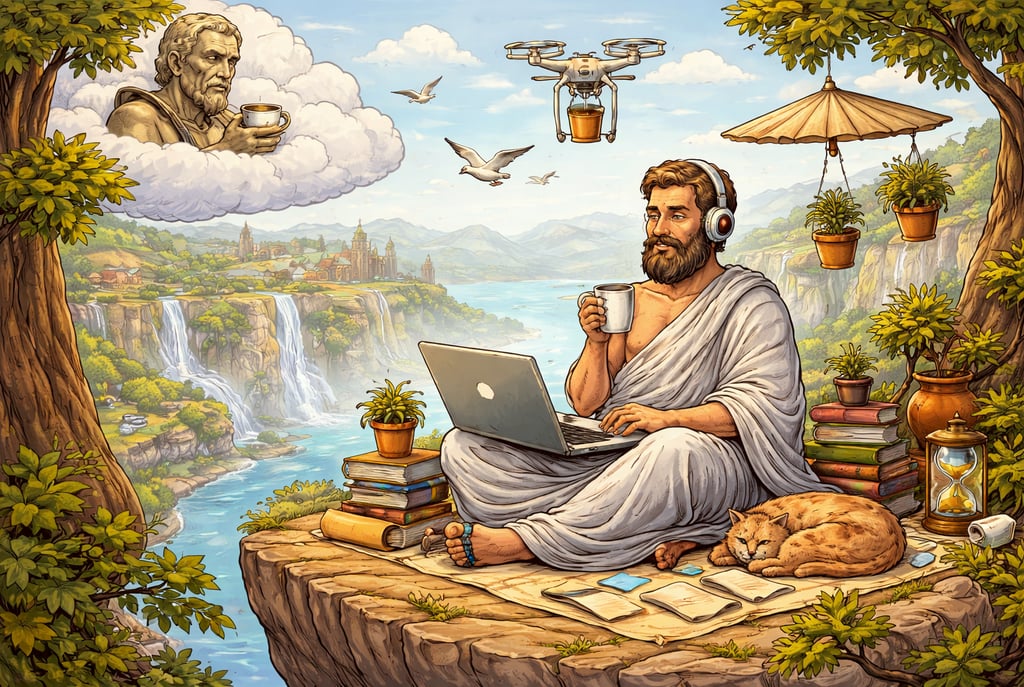
I first noticed it during a particularly unremarkable Monday.
Not dramatic. Not catastrophic. Just one of those mornings where the Slack notifications seemed to multiply quietly in the corner of my screen, like polite but persistent guests at a dinner party. A calendar reshuffle. A shifting deadline. A gentle but unmistakable sense that everything was moving just slightly faster than I was.
In the middle of that low-level digital hum, I remembered a line from Epictetus: “Some things are in our control and others not.”
It felt almost comically misplaced. Ancient Stoic advice whispering into a Zoom room full of screen shares and quarterly targets. A Roman philosopher calmly observing human nature while I toggled between Notion and Google Docs.
And yet — it didn’t feel absurd.
It felt steady.
Over the past year, I’ve noticed Stoicism resurfacing in remote work culture in the quietest way. Not as aesthetic branding. Not as a viral productivity hack. But as something subtler — a background philosophy woven into leadership newsletters, startup podcasts, Slack conversations about burnout, and even casual comments in digital stand-ups.
No one announced it. No one built a course around it (at least not loudly). It’s just there, gently shaping how people respond to volatility.
Which made me wonder: why does this ancient philosophy feel so unexpectedly at home inside our hyper-connected work lives?
It shouldn’t fit.
It does.
The Subtle Strain of Working Everywhere
Remote work gave us freedom. That much is true.
Freedom from commuting. From fluorescent lighting. From rigid nine-to-five rhythms. We gained autonomy over where we sit, how we structure our day, what music plays in the background.
But autonomy came with permeability.
Slack replaced hallway taps. Email replaced quick clarifications. Zoom replaced conference rooms — only without the natural pauses and social cues that once signaled transitions. The workday no longer ended when you physically left the office. It lingered. It hovered.
Many distributed workers describe what researchers now call “ambient stress” — not acute burnout, but a steady awareness of unfinished threads. Of potential notifications. Of conversations happening across time zones while you sleep.
You cannot control when someone pings you.
You cannot control market swings.
You cannot control sudden pivots in company strategy.
And trying to control all of it is exhausting.
This is where Stoicism quietly enters the room.
Not to eliminate the noise.
But to recalibrate your relationship to it.
The Dichotomy of Control, Reimagined for Slack
At the heart of Stoicism is a deceptively simple framework: the dichotomy of control.
Epictetus divided life into two categories — what is within your control and what is not. Your judgments. Your intentions. Your actions. Those are yours. External events. Other people’s reactions. Outcomes. Not entirely yours.
Translated into remote work, the distinction becomes almost tangible.
You cannot control:
Whether your email is interpreted the way you intended.
Whether a proposal is accepted.
Whether leadership shifts priorities mid-quarter.
Whether economic headlines ripple through your industry.
You can control:
The clarity of your message.
The integrity of your effort.
The steadiness of your tone.
Your response to feedback.
A product manager I spoke with described starting each week by listing two columns in her digital journal: “Within My Control” and “Not Mine.”
The second column is often longer.
But instead of discouraging her, it frees her.
“It’s like emotional budgeting,” she said. “I decide in advance what deserves my energy.”
Emotional budgeting.
That phrase feels particularly modern. In an era of infinite digital inputs, attention is currency. Stoicism becomes less about lofty philosophy and more about disciplined allocation of mental resources.
It reframes Slack from a stressor to a neutral channel.
It reframes volatility from a threat to a variable.
It doesn’t shrink your responsibilities. It clarifies them.
Where Metrics Meet Marcus Aurelius
Modern work culture thrives on measurement.
Dashboards glow with KPIs. Engagement metrics update in real time. OKRs cascade across organizational charts. Performance is quantified, graphed, tracked.
There’s clarity in numbers. But there’s also fragility. When identity fuses with metrics, fluctuations feel personal.
Stoicism gently loosens that fusion.
Marcus Aurelius wrote extensively about effort over outcome. About virtue in action rather than validation in result. For a Roman emperor managing an empire, this wasn’t abstract reflection — it was survival.
In distributed teams today, the principle feels surprisingly relevant.
A startup founder I interviewed described placing a printed line from Meditations near his desk: “You have power over your mind — not outside events.”
He doesn’t reference it in investor meetings. It’s not part of company onboarding. It’s private scaffolding.
When product launches underperform or funding conversations stall, the quote serves as proportion. Not dismissal. Not detachment. Just scale.
It’s the productivity equivalent of discovering your most intense venture capitalist reads Seneca on weekends.
Unexpected. Slightly charming. Surprisingly coherent.
The Practical Harmony in Daily Workflows
What fascinates me most is how Stoicism slips into daily routines without announcement.
Some remote teams begin planning sessions with a brief reflection prompt: “What is fully within our influence this week?”
Others integrate short breathing pauses before retrospectives — sixty seconds of quiet before dissecting missed targets.
An engineering lead told me he asks himself one question before sending emotionally charged messages: Am I responding to something I can control?
He estimates it has reduced reactive emails by half.
That’s not dramatic. It won’t trend. But it changes culture.
Tone shapes trust.
Trust shapes collaboration.
Collaboration shapes performance.
In that sense, Stoicism becomes operational.
Even asynchronous communication echoes this philosophy. Writing thoughtful updates instead of reacting instantly requires restraint. It demands clarity over impulse. It favors response over reaction.
That alignment feels almost inevitable.
The Aesthetic of Calm in a Digital Landscape
There’s also a visual harmony in this pairing.
Remote workspaces often reflect mental aspiration. Minimalist desks. Soft lighting. Neutral color palettes. Carefully arranged bookshelves visible in video calls.
Imagine an image here: a clean home office desk, laptop open to a project dashboard, a ceramic mug cooling beside it — and next to the keyboard, a slim, worn copy of Epictetus with a page marked.
Take a moment with that image.
Notice how the stillness of paper balances the glow of the screen. How the weight of a physical book contrasts with the impermanence of notifications.
It shouldn’t feel cohesive.
It does.
The aesthetic mirrors the philosophy: modern efficiency anchored by ancient steadiness.
Stoicism in Leadership Circles
Perhaps most interesting is how quietly Stoicism has entered executive dialogue.
Not as branding. Not as performance theater. But as emotional infrastructure.
Leadership newsletters reference “amor fati” — loving one’s fate — when discussing market turbulence. Podcasts explore resilience not as dominance but as composure. Venture capitalists mention Marcus Aurelius alongside SaaS growth metrics without irony.
One CEO described ending weekly team updates with a simple question: “What did we respond well to this week?”
Not “What did we conquer?”
Responded.
The language shift is subtle. The impact is not.
When uncertainty becomes constant — technological acceleration, AI integration, geopolitical shifts — inner steadiness becomes strategic.
Stoicism doesn’t promise control over chaos.
It promises composure within it.
That distinction feels increasingly valuable.
Why This Pairing Feels Strangely Right
Remote work amplifies autonomy. And autonomy demands self-regulation.
Without physical boundaries, you choose when to check Slack. You choose when to step away. You choose whether to escalate or de-escalate tension.
That level of freedom can be exhilarating. It can also be destabilizing.
Stoicism supplies guardrails without rigidity.
It reframes setbacks as training.
It reframes praise as temporary.
It reframes uncertainty as neutral terrain.
In a culture obsessed with optimization — biohacking sleep, perfecting routines, chasing efficiency — Stoicism feels refreshingly low-tech.
No subscription required.
No dashboard needed.
No algorithm to appease.
Just a daily reminder that your response remains yours.
It’s sustainable elegance.
A Gentle Recalibration of Ambition
None of this erases ambition.
If anything, it steadies it.
When identity detaches slightly from metrics, effort becomes purer. Work becomes less about proving and more about practicing.
You still build.
You still strive.
You still care deeply.
But the volatility of outcomes no longer dictates your emotional climate.
It’s not about conquering the inbox.
It’s about deciding what deserves your energy.
It’s not about eliminating stress.
It’s about placing it in proportion.
And proportion, in a remote-first era, might be the quiet advantage.
The Broader Reflection
When ancient wisdom slips into fast-moving tech teams, it reveals something quietly comforting.
Progress does not erase the past.
It absorbs it.
Philosophy isn’t decorative. It’s durable.
In a world of AI assistants drafting replies and dashboards updating in real time, the most radical act may be a deliberate pause.
A breath before response.
A question before reaction.
A steady glance inward before looking outward.
That delightful dissonance — Stoic calm meeting Slack chaos — resolves into unexpected harmony because both seek sustainability.
Not frantic growth.
Sustainable clarity.
Have you noticed other gentle collisions in business, technology, or lifestyle that felt strangely right? The quiet mashups that didn’t shout, but lingered?
We’re collecting them.
Until the next thoughtful fusion appears in our feeds.
More quiet wonders soon.