
Stoicism Meets Economic Volatility: How Focusing on What You Control Turns Uncertainty into Opportunity
Explore how Stoic philosophy is helping leaders navigate economic volatility in 2026. From market instability and capital shifts to emotional resilience and operational discipline, discover how focusing on what you control can transform uncertainty into opportunity and build sustainable business momentum in unpredictable times.
12/15/20255 min read
I first noticed it during a quarterly board call that should have felt tense.
Markets had been unpredictable for weeks. Headlines swung between cautious optimism and subtle alarm. AI funding surged in one sector while cooling abruptly in another. Interest rates ticked upward again. A competitor had just announced layoffs.
The slide deck looked familiar — projections, scenario modeling, revised forecasts shaded in sober colors.
But instead of opening with defensive language, the CEO began with something almost disarmingly simple.
“Let’s separate what’s in our control from what isn’t.”
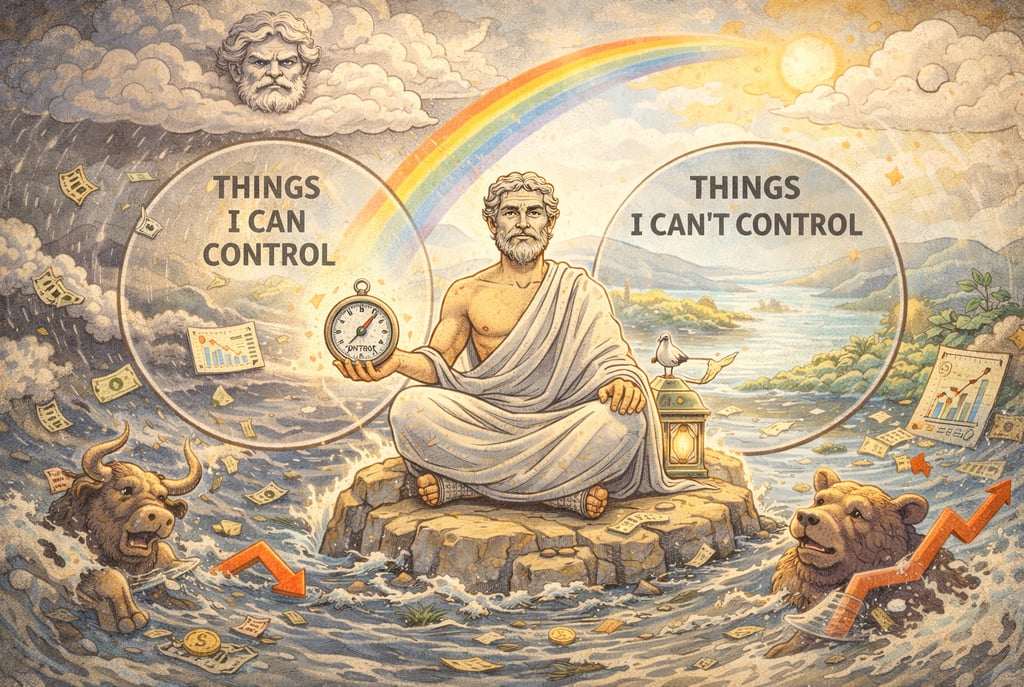
No dramatic philosophy lecture. No grand declarations. Just a whiteboard divided into two columns.
Exchange rates? Not ours.
Geopolitical shifts? Not ours.
Customer trust? Ours.
Product reliability? Ours.
The tone shifted almost immediately.
Not toward denial. Toward clarity.
In times of volatility, businesses often chase prediction. We hire analysts. We refresh dashboards. We scroll financial feeds at midnight hoping the data will stabilize.
But prediction has limits.
Control, by contrast, feels tangible.
Stoicism — the ancient philosophy rooted in focusing on what lies within your power — has quietly re-entered executive thinking. Not as branding. Not as aesthetic quotes framed in minimalist offices. But as operational posture.
It shouldn’t feel relevant in AI-driven markets and algorithmic trading cycles.
It does.
The Atmosphere of 2026: Constant Recalibration
Economic cycles once felt seasonal.
Now they feel instantaneous.
Global markets react within minutes to policy announcements. AI advancements reshape industries in quarters rather than decades. Supply chains recalibrate overnight. Capital shifts direction with remarkable speed.
For founders and executives, this environment produces a peculiar tension.
Agility is rewarded. Move quickly. Pivot decisively. Adjust pricing models. Reallocate capital. But if every headline prompts a new strategic posture, coherence dissolves.
A venture-backed CEO described it plainly: “If we let the news cycle dictate our roadmap, we’d rewrite it every week.”
There is fatigue in perpetual adjustment.
Volatility compresses timelines. It amplifies comparison. It invites reactive decision-making.
Stoicism does not promise stability in markets.
It narrows the field of response.
That narrowing is surprisingly liberating.
The Dichotomy of Control in a Market Context
At the heart of Stoic philosophy lies the dichotomy of control — the idea that some things are within our influence and others are not.
Marcus Aurelius wrote about this while managing an empire beset by wars and plagues. Modern executives manage earnings calls and investor sentiment, but the emotional mechanics are not entirely different.
Consider the list of variables during economic turbulence.
You cannot control:
Inflationary trends.
Central bank policy decisions.
Venture capital appetite.
Market sentiment fluctuations.
Global political unrest.
You can control:
Cash flow discipline.
Hiring rigor.
Customer communication.
Product iteration cadence.
Cultural resilience.
The list is shorter.
But it is actionable.
One CFO shared that during volatile quarters, her team opens meetings by categorizing agenda items into two buckets: “Influence” and “Observe.”
Topics in the “Observe” column receive monitoring, not panic. They are noted, not emotionally escalated.
The temperature of meetings changed.
It shouldn’t feel strategic to write things into columns.
It does.
Where Ancient Calm Enters Modern Boardrooms
It’s quietly fascinating how often Stoic language surfaces in executive conversations now, even when the philosophy isn’t named.
Resilience. Perspective. Emotional discipline. Long-term thinking.
A renewable energy founder described keeping a printed line from Epictetus near his desk: “It’s not what happens to you, but how you react to it that matters.”
He never quotes it in investor decks.
But when supply chain delays disrupted timelines, he referenced the principle internally. “We can’t control shipping congestion,” he told his team. “We can control how transparently we communicate.”
Customer retention improved despite delays.
Another CEO shifted language during a downturn from “defensive posture” to “disciplined focus.”
The semantics mattered.
Defensive implies fear. Disciplined implies intention.
That subtle reframing stabilized morale.
Visual Integration: The Two-Column Strategy Board
Imagine a whiteboard divided cleanly down the center.
On the left side: headlines about inflation, fluctuating exchange rates, competitor funding announcements, geopolitical uncertainty.
On the right side: cost optimization plans, product roadmap milestones, customer engagement metrics, hiring standards.
Take a moment with that image.
The left column feels expansive and noisy. The right column feels narrower and manageable.
The exercise does not shrink volatility.
It clarifies agency.
Agency restores composure.
The Practical Opportunity Inside Constraint
Volatility constrains resources.
Capital tightens. Hiring slows. Expansion plans pause.
Yet constraint often sharpens clarity.
A consumer-tech founder described discovering hidden inefficiencies during a funding slowdown. “We were spending like growth was guaranteed,” he admitted. “When volatility hit, we had to revisit fundamentals.”
Marketing spend was re-evaluated. Vendor contracts renegotiated. Internal processes streamlined.
Revenue growth slowed temporarily.
Profitability improved.
Opportunity emerged not from favorable conditions, but from disciplined response.
Stoicism reframes constraint as training rather than punishment.
In that framing, volatility becomes catalyst.
Emotional Regulation as Strategic Asset
Economic instability does not only affect spreadsheets.
It affects psychology.
Investor calls can amplify anxiety. Media narratives magnify fear. Social comparison within tech ecosystems fuels insecurity.
Stoicism emphasizes emotional regulation — not suppression, but observation.
A startup advisor noted that the founders who navigate downturns most effectively are not necessarily those with the most capital, but those with the most composure.
Composure influences communication.
Communication influences morale.
Morale influences productivity.
Productivity shapes outcome.
The calmest person in the room often makes the clearest decision.
It sounds understated.
It is competitive advantage.
Reframing Volatility as Neutral Terrain
Stoicism does not label events as inherently good or bad.
It emphasizes interpretation.
Market downturns create acquisition opportunities. Talent becomes available. Competitors retreat. Customer needs shift in ways that reward adaptable firms.
But opportunity is visible only to those not consumed by panic.
A SaaS founder shared that during a period of declining valuations, his team doubled down on product quality rather than fundraising optics.
“We couldn’t control investor sentiment,” he explained. “But we could control what users experienced.”
User retention improved. Investor confidence followed later.
Response preceded recovery.
The delightful dissonance of ancient philosophy guiding AI-era strategy resolves into coherence because human psychology remains constant.
Markets are volatile.
Response is optional.
Sustainable Strategy Over Reactive Movement
Reactive decision-making often feels productive.
Rapid pivots. Emergency cost cuts. Overcorrecting in response to fear.
But constant reaction erodes identity.
Stoicism introduces pause.
Pause creates space between stimulus and action.
In that space lies choice.
A mid-stage startup introduced a rule during volatile periods: no strategic pivot without 48 hours of reflection unless legally required.
The delay reduced impulsive shifts.
Some ideas dissolved naturally. Others matured.
The practice felt simple.
Its impact compounded.
Why This Resonates in 2026
In 2026, volatility feels structural rather than episodic.
AI integration accelerates disruption. Climate events affect supply chains. Political shifts influence capital allocation. Markets oscillate rapidly.
In such an environment, prediction grows unreliable.
Control remains concrete.
Stoicism does not promise certainty.
It promises clarity about where to place effort.
Effort placed within influence compounds over time.
Compounding resilience outlasts fleeting optimism.
A Gentle Reframing of Opportunity
Opportunity during volatility rarely announces itself.
It appears as discomfort. Constraint. Recalibration.
But when leaders focus on controllable levers — culture, customer trust, operational excellence — volatility becomes manageable terrain rather than existential threat.
The charming contradiction of ancient Roman reflection guiding AI-powered enterprises reveals something timeless.
Technology evolves.
Human reaction patterns do not.
Focusing inward before responding outward stabilizes strategy.
The Broader Reflection
When Stoicism meets economic volatility, something quietly modern emerges.
Ancient wisdom becomes operational strategy.
Focusing on what you control does not shrink ambition.
It concentrates it.
Markets will fluctuate. Headlines will oscillate. Technologies will advance.
What remains steady is response.
Response shapes trajectory.
It shouldn’t feel grounding to read Marcus Aurelius in an age of machine learning and high-frequency trading.
It does.
Have you noticed leaders who navigate turbulence with unusual calm? Organizations that seem steady while others scramble?
We’re collecting those.
Until the next thoughtful intersection of old wisdom and new uncertainty.
More quiet wonders soon.