
The Quiet Charm of Imperfection in AI-Driven Workflows: When “Good Enough” Wins
Discover how embracing imperfection in AI-driven workflows is reshaping productivity in 2026. From automated meeting summaries and draft emails to collaborative editing and strategic prioritization, explore why accepting “good enough” outputs can increase efficiency, spark creativity, and create sustainable momentum in modern business environments.
11/10/20255 min read
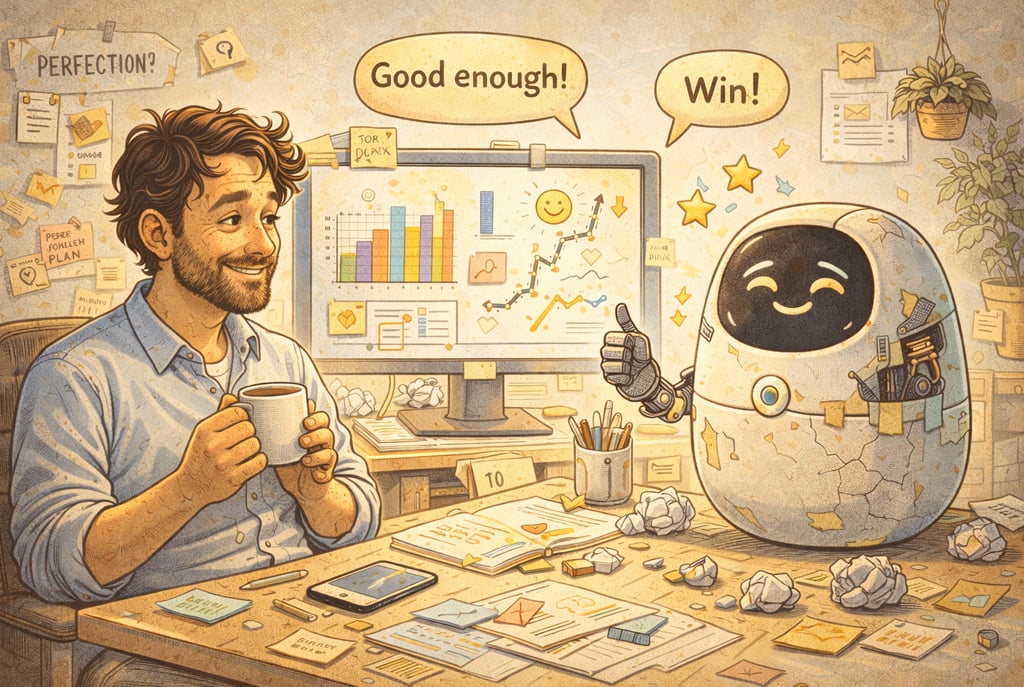

I noticed it in a Slack recap that was almost right.
An AI assistant had summarized a strategy meeting into clean bullet points. The deadlines were correct. The action items were assigned. The tone was professional — perhaps slightly more polished than anyone on the team actually sounds on a Tuesday afternoon.
There was one phrase that felt just a little off. Not incorrect. Just smoother than our usual cadence. Someone could have rephrased it. Someone could have regenerated the summary to see if a better version appeared.
Instead, a teammate replied, “Looks good — sending.”
And that was that.
A year ago, we would have edited it line by line. Tweaked the phrasing. Adjusted the rhythm. Nudged it toward something indistinguishable from handcrafted prose.
Now, we let it stand at 95%.
Not out of laziness. Out of intention.
In a world where AI outputs can be endlessly refined — regenerated, optimized, smoothed — the decision to stop at “good enough” feels quietly radical.
Perfection, it turns out, is expensive.
Imperfection, when chosen thoughtfully, can be efficient. Human. Even creative.
It shouldn’t feel comforting to accept small flaws in AI-generated work.
It does.
The Rise of Flawless Expectations
The first wave of AI adoption in knowledge work arrived with a particular promise: precision at scale.
Perfect grammar. Instant summaries. Clean outlines. Optimized messaging. Flawless formatting delivered in seconds.
For teams drowning in drafts, documentation, and email threads, it felt miraculous. Why spend twenty minutes organizing notes when an AI tool can structure them in ten seconds?
But something subtle happened.
As outputs improved, expectations rose. When AI could produce polished prose instantly, the baseline shifted. Rough drafts felt less acceptable. Internal memos grew more refined. Even casual updates began to carry a sheen of editorial precision.
The bar moved quietly upward.
And with it came a new pressure: if perfection is accessible, why settle for less?
The paradox is gentle but persistent. When flawless output becomes easy, the compulsion to achieve it intensifies.
But flawless output also consumes attention.
And attention is finite.
Where Human Texture Meets Machine Precision
AI excels at structure.
It organizes thoughts into logical flows. It identifies themes in conversation transcripts. It drafts subject lines with crisp clarity.
Yet it is not infallible.
Sometimes it over-polishes. Sometimes it misreads emotional nuance. Sometimes it inserts phrasing that is technically accurate but emotionally distant.
A product team I spoke with described receiving AI-generated sprint summaries that felt “slightly too enthusiastic.” The exclamation points were grammatically correct. The energy, however, did not match the team’s understated culture.
At first, they corrected every instance.
Eventually, they stopped.
“It’s close enough,” one engineer shrugged. “We know what it means.”
The small imperfections no longer felt like errors to eliminate. They felt like traces of collaboration.
The machine drafts. The human decides.
That subtle distinction shifts the tone of adoption from anxious oversight to pragmatic partnership.
The Cost of Chasing 100%
There is a practical dimension to this cultural adjustment.
In many workflows, the difference between 95% and 100% refinement yields minimal functional gain. The extra minutes spent polishing phrasing often do not alter understanding or outcome.
An operations manager at a remote-first company described tracking time spent editing AI-generated weekly reports. Before AI integration, the report took roughly two hours to draft and refine. After automation, the first version appeared in minutes.
Initially, the team spent 30 additional minutes refining tone and formatting. Over time, they reduced editing to ten minutes.
No complaints emerged. No clarity was lost.
The time saved compounded across quarters.
This does not suggest that precision lacks value. Legal contracts, compliance documents, and public statements still demand meticulous review.
But in internal workflows — meeting recaps, status updates, early drafts — “good enough” often preserves momentum.
Momentum, in fast-moving teams, carries strategic weight.
Visual Integration: A Draft with Slight Edges
Imagine two versions of a project update.
The first is an AI-generated draft: cleanly structured, slightly formal, perhaps carrying a phrase that feels marginally over-optimized.
The second is a fully human-edited version: tone adjusted, adjectives softened, cadence aligned perfectly with team voice.
Place them side by side.
The differences are subtle. Most readers would not detect them without close inspection.
And yet, the decision not to polish every edge preserves something else — time, flow, continuity.
Take a moment with that image.
Notice how small the gap is.
Notice how much energy can be reclaimed by accepting it.
Imperfection as Creative Friction
There is another unexpected benefit to allowing slight imperfections in AI outputs.
Friction can spark creativity.
A slightly awkward phrase may prompt reconsideration of a concept. A misaligned emphasis may reveal an overlooked angle. An unusual metaphor may introduce fresh perspective.
A creative director described intentionally leaving certain AI quirks in early drafts because they “nudge the room sideways.”
Sideways thinking often produces originality.
If every draft were flawlessly conventional, creative exploration might narrow.
In that sense, minor imperfection becomes a catalyst rather than a liability.
It introduces texture.
Texture invites engagement.
The Emotional Shift: From Critic to Collaborator
The relationship between humans and AI tools has evolved rapidly.
At first, many teams approached AI outputs with suspicion. Every line was scrutinized. Every claim double-checked. The tool felt like an intern whose work required meticulous oversight.
Over time, familiarity breeds pragmatism.
A founder described the transition as “moving from editing like a critic to editing like a collaborator.”
That shift feels significant.
A critic seeks flawlessness. A collaborator seeks progress.
When AI becomes a collaborator, minor imperfections signal partnership rather than threat.
The charming contradiction of embracing machine quirks in professional workflows resolves into a surprisingly human dynamic.
We allow for imperfection not because we lower standards, but because we recalibrate priorities.
Guardrails: When Precision Protects Trust
Of course, discernment remains essential.
There are contexts where precision is non-negotiable. Financial disclosures. Medical documentation. Public policy statements. Client-facing legal agreements.
In those arenas, AI outputs require rigorous review and refinement.
The key lies in distinguishing between essential perfection and optional perfection.
Essential perfection safeguards trust.
Optional perfection often consumes time without proportionate benefit.
A marketing team implemented a simple guideline: internal drafts receive one round of human refinement. External materials receive two.
This boundary preserves quality while preventing over-polishing.
Mindfulness, in this context, means knowing when to stop.
Why This Resonates in 2026
AI tools are no longer novelties. They are infrastructure.
From drafting proposals to summarizing research, machine assistance is embedded in daily workflows across industries.
As adoption normalizes, teams shift from fascination to functionality.
The question changes from “How perfect can we make this?” to “Is this sufficient?”
That subtle reframing reflects maturity.
In a culture historically enamored with optimization, accepting sufficiency feels quietly subversive.
Excellence does not always require immaculate symmetry.
It often requires timely clarity.
Perfection slows.
Good enough flows.
Flow sustains progress.
Sustainable Momentum Over Spectacle
There is a cultural dimension to this shift as well.
Early AI adoption carried spectacle — dramatic demos, bold claims, impressive outputs shared publicly.
Now, integration feels quieter.
AI drafts meeting summaries in the background. It suggests edits without fanfare. It proposes outlines while teams focus on strategy.
The spectacle fades. Utility remains.
In that quiet utility, imperfection feels less threatening.
If AI is not performing for applause but assisting for efficiency, minor flaws become inconsequential.
What matters is momentum.
Momentum compounds.
A Gentle Recalibration of Standards
Accepting imperfection in AI-driven workflows does not mean abandoning excellence.
It means redefining it.
Excellence becomes alignment with purpose rather than alignment with perfection.
If the goal of a status update is clarity, and clarity is achieved at 95%, then the objective is met.
If the goal of a brainstorm draft is idea generation, and ideas flow, then minor tonal quirks are secondary.
The quiet charm of this recalibration lies in its humility.
We are not outsourcing judgment.
We are reallocating attention.
The Broader Reflection
When AI-driven workflows meet a willingness to embrace imperfection, something unexpectedly balanced emerges.
Automation gains humanity.
Efficiency gains proportion.
Productivity gains sustainability.
The delightful dissonance of machine precision meeting human tolerance resolves into harmony because both aim for forward motion.
Not immaculate output.
Sustainable momentum.
It shouldn’t feel liberating to let small flaws remain in a draft.
It does.
Have you noticed moments where “good enough” moved a project forward faster than endless refinement? Where accepting 95% preserved energy for what truly mattered?
We’re collecting those.
Until the next thoughtful friction appears in your workflow.
More quiet wonders soon.