
Wabi-Sabi Aesthetics Meets Sustainable Branding: Why Imperfect Stories Sell Better Now
Discover how wabi-sabi aesthetics are reshaping sustainable branding in 2026. From visible repairs and natural material textures to transparent storytelling and imperfect prototypes, explore why brands embracing authenticity and intentional imperfection are building deeper trust, stronger customer loyalty, and long-term sustainability in a world of digital polish.
2/9/20264 min read
I first noticed it on a product page that felt almost unfinished.
The ceramics weren’t perfectly symmetrical. You could see the slight ripple where the clay had been pressed by hand. The glaze pooled unevenly near the rim, creating a soft gradient instead of a uniform coat. The photography wasn’t aggressively retouched; natural light cast gentle shadows that revealed texture rather than hiding it.
Nothing screamed luxury. Nothing shouted urgency. There was no countdown timer or flashing discount banner.
And yet, I lingered.
In 2026, branding has reached an intriguing inflection point. For years, the dominant visual language leaned toward immaculate precision — spotless white backgrounds, crisp typography, surgically lit product shots, seamless digital interfaces. Every pixel optimized for clarity and conversion.
But lately, a different texture has begun to surface.
Visible stitches. Natural wood grain. Wrinkled linen. Recycled packaging with subtle color variations. Product pages that mention repair before replacement.
It isn’t sloppiness.
It’s intentional imperfection.
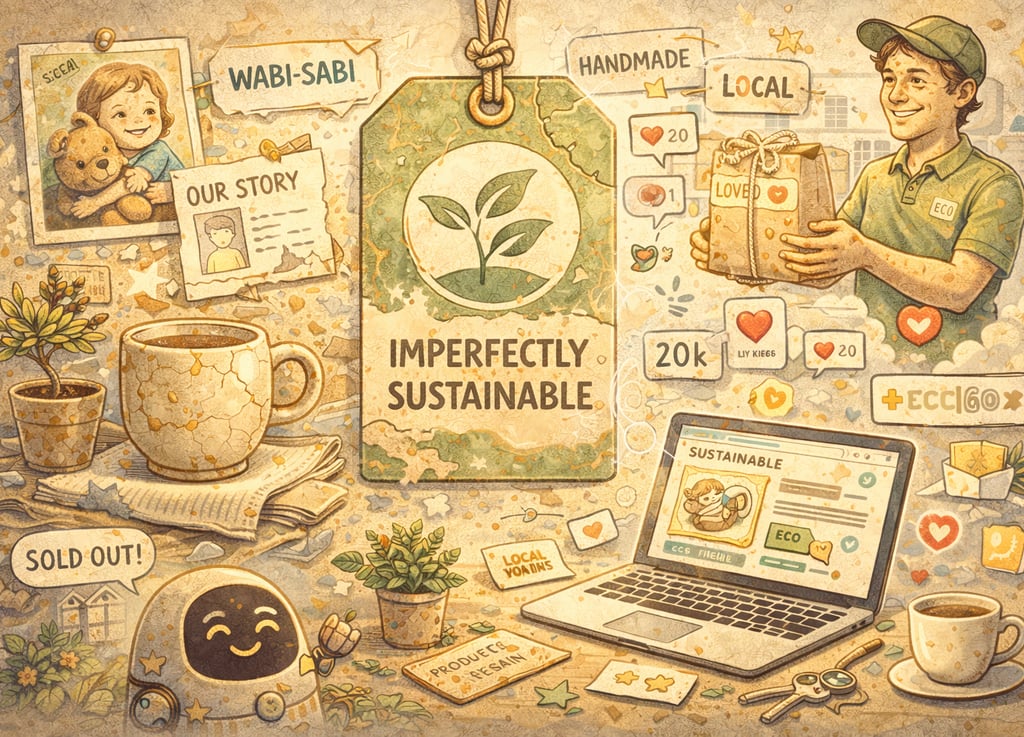
This shift echoes the Japanese philosophy of wabi-sabi — an appreciation for asymmetry, transience, patina, and the quiet beauty of things that are incomplete or evolving.
It shouldn’t feel compelling to see a visible repair seam on a jacket.
It does.
Because in an era of AI-polished perfection, texture feels trustworthy.
Understanding Wabi-Sabi in a Brand Context
Wabi-sabi is often reduced to a simple phrase: “finding beauty in imperfection.” But the philosophy carries deeper resonance.
It honors natural irregularity. It accepts the marks of time. It resists sterile uniformity. It sees weathering not as decline but as character.
Applied to branding, wabi-sabi does not suggest carelessness. It suggests authenticity.
Instead of hyper-polished surfaces, brands lean into subtle asymmetry. Instead of flawless prototypes, they reveal iteration. Instead of promising immortality, they acknowledge wear.
A sustainable footwear company recently redesigned its homepage to feature early sample prototypes — scuffed soles, uneven stitching, pencil notes still visible along the edges.
“These were our first attempts,” the caption reads. “They weren’t perfect. They taught us everything.”
The conversion rate improved.
It shouldn’t feel strategic to highlight early mistakes.
It does.
Because transparency signals confidence.
The Saturation of Digital Perfection
For over a decade, digital branding trended toward frictionless perfection.
Minimalist layouts. Symmetrical grids. High-definition product renders free from visual noise. Lifestyle photography polished to cinematic clarity.
This aesthetic was effective. It conveyed control, sophistication, and aspiration.
But saturation breeds skepticism.
When AI tools can generate flawless product imagery in seconds and refine copy to immaculate smoothness, perfection becomes abundant.
Abundance reduces distinction.
Consumers have grown adept at sensing polish that feels synthetic. Over-lit product shots can appear detached from lived experience. Immaculate surfaces can feel distant.
A skincare brand that once airbrushed every campaign recently shifted to unedited skin photography. Freckles visible. Fine lines intact. Pores unblurred.
Engagement rose significantly.
Reality, it turns out, resonates.
Visual Integration: Texture Versus Gloss
Imagine two images placed side by side.
On the left: a perfectly symmetrical ceramic mug, photographed against a stark white background, evenly lit, digitally smoothed.
On the right: the same mug resting on a wooden table, subtle glaze variation visible, perhaps a faint thumbprint indentation along the handle.
Take a moment with both.
The first feels optimized.
The second feels personal.
Consumers increasingly gravitate toward the latter.
Not because it is flawless.
Because it feels lived.
Sustainability and the Language of Imperfection
Sustainable products rarely conform to industrial uniformity.
Recycled fibers vary slightly in tone. Handcrafted goods carry minor asymmetries. Natural materials age.
Wabi-sabi aesthetics align organically with sustainability because both reject disposability.
A clothing brand now offers visible mending services. Instead of hiding repair stitches, they use contrasting thread and celebrate the mend as part of the garment’s evolving story.
Customers post photos proudly. The repair becomes a badge of longevity.
Repair becomes narrative.
Narrative becomes loyalty.
It shouldn’t feel desirable to purchase something that acknowledges wear.
It does.
Because durability is aspirational in its own quiet way.
The Psychology of Imperfect Trust
Psychologists have observed the “pratfall effect” — the idea that small imperfections can increase likability, particularly when competence is already established.
Brands that demonstrate capability while acknowledging limitations often feel more human.
A direct-to-consumer food company shared a behind-the-scenes video of a failed batch during product testing. The founder explained what went wrong and what they learned.
The video outperformed polished product announcements.
Consumers do not expect perfection.
They expect sincerity.
Sincerity reduces distance.
Distance erodes trust.
Storytelling as Sustainable Strategy
Sustainable branding increasingly emphasizes process over polish.
Where were materials sourced? How were workers compensated? What happens at end-of-life?
These questions invite transparency.
A furniture company now includes wood grain variability disclaimers in its product descriptions. “No two tables are identical,” they write. “Natural variation is part of the design.”
Customers respond positively.
The acknowledgment transforms variability into virtue.
It reframes imperfection as individuality.
Individuality deepens attachment.
Why This Resonates in 2026
In 2026, AI-generated visuals can achieve near-photographic perfection. Product mockups can be rendered without physical prototypes. Copy can be optimized endlessly.
Against this backdrop, visible irregularity feels grounding.
It suggests human hands. Time. Effort. Iteration.
The charming contradiction of imperfection within highly engineered commerce resolves into coherence because sustainability itself resists disposability.
Imperfect objects age.
Perfect illusions vanish.
Consumers increasingly prefer the former.
The Economic Advantage of Honesty
There is a practical dimension to this aesthetic shift.
Brands that embrace transparency reduce the cost of maintaining illusion. They spend less on excessive retouching. They communicate durability over novelty. They foster repair rather than replacement cycles.
Long-term customer value increases.
A sustainable denim company now markets fading patterns as “unique signatures” rather than defects. They provide guides for patching and customizing worn areas.
Customers return not for new jeans, but for repair kits.
The business model evolves.
Imperfect stories become revenue streams.
Visual Integration: The Visible Mend
Imagine a jacket sleeve with a contrasting stitch tracing a repaired tear.
The thread color stands out deliberately. It does not attempt invisibility.
Take a moment with that image.
The repair does not diminish the garment.
It enriches it.
The story is visible.
Visibility invites conversation.
Imperfection as Competitive Differentiation
In crowded digital marketplaces, differentiation often comes through aesthetics.
When competitors present hyper-polished images and uniform messaging, a brand that embraces visible texture stands apart.
A sustainable candle company photographs its products mid-burn, wax slightly uneven along the rim. The imperfections signal authenticity.
Customers report feeling less intimidated by the product. It feels usable, not precious.
Usability builds relationship.
Relationship builds loyalty.
The Broader Reflection
When wabi-sabi aesthetics meet sustainable branding, something quietly transformative emerges.
Imperfection becomes credibility.
Texture becomes trust.
Honesty becomes strategic advantage.
It shouldn’t feel compelling to see a visible seam or uneven glaze.
It does.
Because in a world saturated with algorithmic perfection, irregularity feels real.
Have you noticed brands leaning into texture rather than gloss? Stories that reveal process instead of perfection?
We’re collecting those.
Until the next thoughtful collision between philosophy and commerce appears.
More quiet wonders soon.